

Multimodal Freight Transportation: How to Deliver Faster and Cheaper

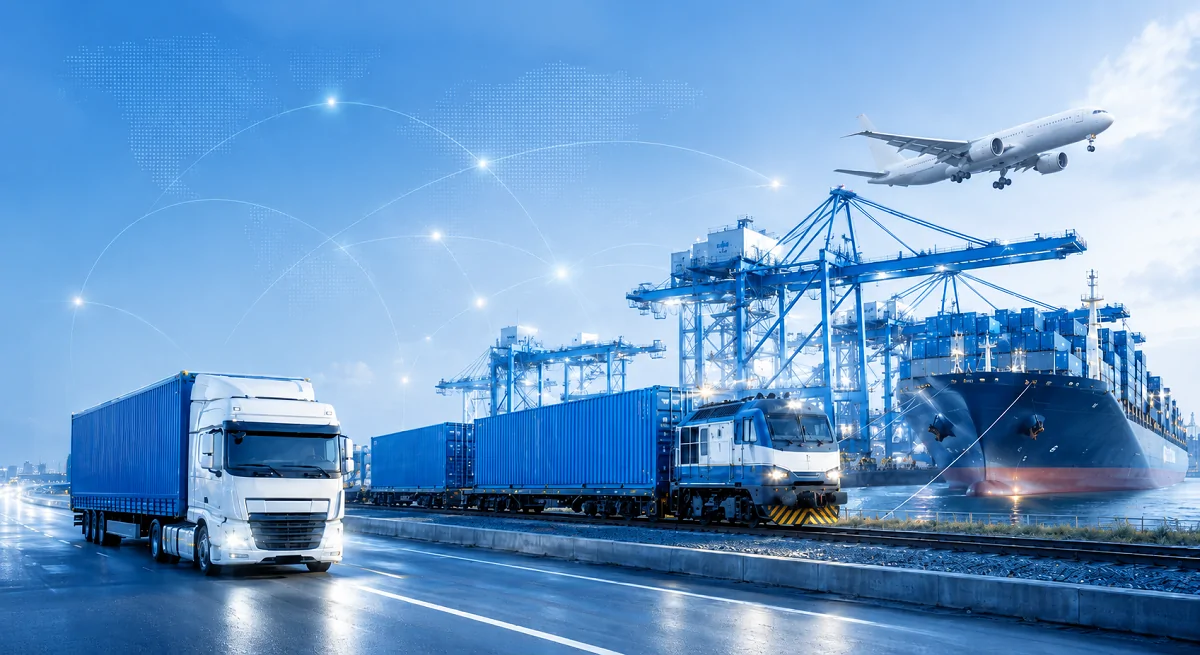
Imagine: you need to deliver cargo from Kharkiv to Warsaw. By truck – it’s slow and expensive due to border queues. By rail alone – there’s no direct connection to the consignee’s warehouse. This is exactly where multimodal transportation comes in – an approach that combines several modes of transport within a single logistics scheme, allowing cargo to be delivered faster, more reliably, and often at a lower cost.
In this article, we’ll explore: what multimodal transportation is, how it works, what benefits it offers businesses, and how to arrange such delivery in Ukraine.
What Is Multimodal Transportation
Multimodal transportation is the movement of cargo using two or more modes of transport under a single contract with one operator. The client signs one contract, receives one transport document, and has one responsible party – regardless of how many modes of transport are used along the route.
A simple example of a multimodal scheme: cargo is picked up by truck from a warehouse in Kyiv → transported by rail to the port of Odesa → loaded onto a container ship to Istanbul → at the destination port, it is handed over to a truck again and delivered to the consignee’s warehouse.
Ekol Logistics: “Multimodality is not just a combination of transport modes. It is a systemic approach to logistics, where each leg of the route is chosen with the cargo, timeline, and client’s budget in mind.”
How Does Multimodal Transportation Differ from Intermodal and Mixed Transportation?
These terms are often confused. Here is the key distinction:
| Type | Number of Contracts | Responsibility | Container Type |
| Multimodal | 1 contract | Single operator | May change |
| Intermodal | 1 contract | Single operator | One container, no cargo reloading |
| Mixed (combined) | Multiple contracts | Distributed among carriers | May change |
The key difference between multimodal and intermodal: in multimodal transportation, cargo may be transferred between different transport units, whereas in intermodal transportation, the cargo itself remains in the same container from start to finish.
How Multimodal Transportation Works: Process Overview
Organizing a multimodal shipment consists of several stages:
- Route analysis and planning. The logistics specialist studies the origin and destination, cargo type, deadlines, and budget. Based on this, an optimal scheme is developed with the selection of transport for each leg.
- Documentation. The client signs a single multimodal transport document (FBL or FIATA Bill of Lading). The operator independently prepares all necessary waybills, bills of lading, and permits for each mode of transport.
- First leg (typically by road). A truck picks up the goods directly from the sender’s warehouse or production facility – door-to-door pickup.
- Transfer point. At a terminal, port, or railway station, the cargo is transferred to the next mode of transport. The logistics specialist coordinates synchronization to avoid delays.
- Main leg. The longest part of the route – rail, sea, or air, depending on the direction and priorities.
- Final leg and delivery. Road transport again delivers the cargo directly to the recipient.
Types of Multimodal Transportation
The choice of a specific scheme depends on the route, cargo type, and speed and cost requirements.
Sea + Road The most common combination for international trade. It combines the cost-efficiency of maritime transport (the lowest cost per ton-kilometer) with the flexibility of road delivery on the “last mile.” Suitable for large volumes of goods between continents.
Rail + Road The ideal solution for large and heavy cargo over distances exceeding 500 km. Rail transport offers up to 3–4 times lower costs compared to road on long legs, while trucks handle delivery to and from the terminal.
Air + Road The fastest scheme – for urgent, high-value, or perishable cargo. Air freight is chosen when time is critical: pharmaceuticals, electronics, spare parts for halted production lines.
Sea + Rail + Road The classic scheme for intercontinental routes such as China–Ukraine. Cargo travels by sea to a European port, then by rail across the border, then by road to the final destination.
Fact: According to industry data, over 90% of all international freight shipments are carried out using mixed schemes – no single mode of transport can provide door-to-door delivery on its own.
Advantages of Multimodal Transportation
Multimodal transportation is regarded as the most balanced logistics tool. Here’s why:
Cost savings Each mode of transport is most efficient on its own leg. Rail is cheaper than road over long distances. Maritime transport is the most economical for large volumes between continents. By combining them, logistics specialists achieve an optimal cost for the entire route – often 20–35% lower than using a single mode of transport.
Reduced delivery times A well-designed scheme allows bottlenecks to be avoided. For example, instead of a long truck route across several borders – a fast sea or rail leg with minimal customs delays.
Single contract and simplified documentation The client deals with one operator and signs one document. No need to separately negotiate with a maritime carrier, a railway company, and a road transport firm.
Reduced commercial risks One operator bears full responsibility for cargo safety and adherence to deadlines. In the event of force majeure – a port strike, weather conditions, an accident – the logistics specialist independently adjusts the route without shifting the problem onto the client.
Logistics flexibility The scheme adapts to any cargo: oversized, hazardous, refrigerated, or consolidated. Multimodal freight transportation makes it possible to deliver goods to destinations no single mode of transport could reach alone.
Disadvantages and Risks of Multimodal Transportation
An objective view is an important part of any decision. Multimodal logistics has its challenges too:
- Coordination complexity. The more legs a route has, the greater the synchronization requirements between carriers. A failure at one node can cause delays throughout the entire chain.
- Risks during cargo transfer. Every transfer is a potential point of damage. Proper packaging and insurance are essential.
- More difficult real-time cargo tracking. Different monitoring systems used by different carriers complicate unified tracking. A professional operator addresses this through a centralized TMS system.
- Longer planning time. Developing a route and coordinating schedules takes time – multimodal transportation is not suitable for urgent, last-minute shipments (air freight is better in such cases).
Documents for Multimodal Transportation
Correct documentation is the key to smooth customs clearance and legal protection of cargo.
| Document | Purpose |
| FBL (FIATA Bill of Lading) | The primary multimodal transport document – confirms the contract and operator’s liability |
| CMR Waybill | For road legs of an international route |
| Bill of Lading | For the sea leg – confirms ownership of the cargo |
| Air Waybill (AWB) | For the air leg |
| CIM/SMGS Waybill | For the rail leg (international conventions) |
| Customs Declaration | When crossing state borders |
| Packing List | Detailed description of shipment contents |
The single operator takes responsibility for preparing and verifying all of these documents – the client does not need to understand the intricacies of each one.
Cost of Multimodal Transportation: What Affects the Price
There is no fixed tariff – each route is calculated individually. The price is influenced by:
- Distance and route – number of legs, availability of transfer points
- Cargo type and characteristics – weight, volume, hazard class, temperature requirements
- Chosen modes of transport – air is more expensive than rail, but faster
- Delivery deadlines – urgency increases the cost
- Seasonality – peak seasons in maritime shipping affect freight rates
- Additional services – insurance, customs clearance, warehousing
As a rough guide: a multimodal “rail + road” scheme for the Kyiv–Berlin route costs 25–40% less than a purely road shipment of the same cargo.
Multimodal Transportation in Ukraine: 2026 Specifics
Multimodal transportation in Ukraine today is an actively developing sector amid wartime conditions and the reorientation of logistics flows. A few relevant highlights:
Growth of rail routes. Ukrzaliznytsia continues to develop container services and intermodal terminals. In 2026, rail remains one of the key tools for export and import across western borders – particularly toward Poland, Slovakia, and Hungary.
Alternative sea routes. Maritime shipments via Constanța (Romania) and Baltic ports are operating steadily and remain an important tool for Ukrainian businesses working with partners in Asia, the Middle East, and Africa.
Expansion of road-rail corridors with the EU. In 2026, multimodal corridors are being actively developed under the TEN-T program and the agreement on a common transport area between Ukraine and the EU, simplifying the movement of cargo across the border.
Digitalization of customs procedures. The introduction of electronic customs declarations and a single-window system is reducing customs processing times at key checkpoints – Yahodyn, Krakivets, Uzhhorod.
How to Choose a Multimodal Transportation Company
The quality of multimodal logistics depends entirely on the operator. What to look for:
- Experience and reputation – how many years the company has been on the market, client reviews, and real case studies
- Own infrastructure – availability of proprietary transport, warehouses, and an agent network at transfer points
- Technology – whether a TMS system is available for real-time cargo tracking
- Insurance – whether the company offers cargo insurance and on what terms
- Customs expertise – especially important for international multimodal routes
- Pricing transparency – clear calculations with no hidden surcharges
Multimodal delivery from Ekol Logistics offers a full range of services: from route planning to customs clearance and insurance. The company has its own fleet, partners at key ports and rail hubs, and a TMS system for transparent tracking.
Conclusion
Multimodal freight transportation is not just a logistics tool – it is a strategic decision for businesses that want to deliver goods faster, more reliably, and at a lower cost. The right combination of transport modes makes it possible to overcome geographical limitations, optimize expenses, and focus on the business – while an experienced operator handles all logistics tasks.
Ekol Logistics organizes multimodal transportation along international routes. Calculate the cost of your route – submit a request and our manager will contact you within one business day.
FAQ
What is multimodal transportation in simple terms?
It is the delivery of cargo using several modes of transport – for example, by truck, then by train, then by truck again – under a single contract with one operator who is responsible for the entire route.
How does multimodal transportation differ from regular transportation?
Regular transportation uses one mode of transport and one contract. Multimodal transportation uses several modes of transport, but still involves a single contract and a single responsible operator.
How much does multimodal transportation cost?
The cost is calculated individually for each route and cargo. In general, a multimodal scheme can reduce costs by 20–40% compared to using a single, more expensive mode of transport (such as air or road over long distances).
What documents are required for multimodal transportation?
The primary document is the multimodal transport waybill (FBL). Additionally: a CMR for road transport, a bill of lading for sea transport, an AWB for air transport, and a customs declaration. The operator prepares all documents independently.
Can cargo be tracked during multimodal transportation?
Yes. Professional operators, including Ekol Logistics, provide access to a tracking system that shows the cargo status at every leg of the route in real time.
What types of cargo can be transported multimodally?
Virtually any: standard, oversized, hazardous, refrigerated, or consolidated shipments. The scheme is adapted to the characteristics of each specific cargo.
Where can I learn more about multimodal transportation?
Contact the managers at Ekol Logistics – they will provide a free consultation and calculate the cost for your specific route.
read more
Similar articles

Everyday consumer goods dictate their own rules of the game for logistics. Fast turnover, short shelf lives, a wide distribution network and high retailer expectations all shape a distinct segment of the logistics market.

Modern business is not only about product and sales. It is a complex network of connections between raw material suppliers, manufacturers, warehouses, transport and final points of sale

Every product that reaches the hands of a Ukrainian consumer must carry clear and complete information about the manufacturer, composition, shelf life and other essential characteristics.
Ukraine’s economy is increasingly oriented toward foreign markets, and Ukraine’s exports in 2026 have undergone significant structural changes compared with previous years
Proper tractor transport across Ukraine starts with assessing the machine’s dimensions and selecting the right type of transport. This approach helps avoid fines and delays along the route.
For years, the domestic market relied on purchases from the PRC, but the era of Chinese factory monopoly is gradually coming to an end. Entrepreneurs are turning to other Asian countries, weighing product quality and partner reliability.

Anna
Business development manager

Volodymyr
Business development manager

Artur
Business Development Manager
