

Export Declaration EX-1: Everything You Need to Know About Export Customs Clearance

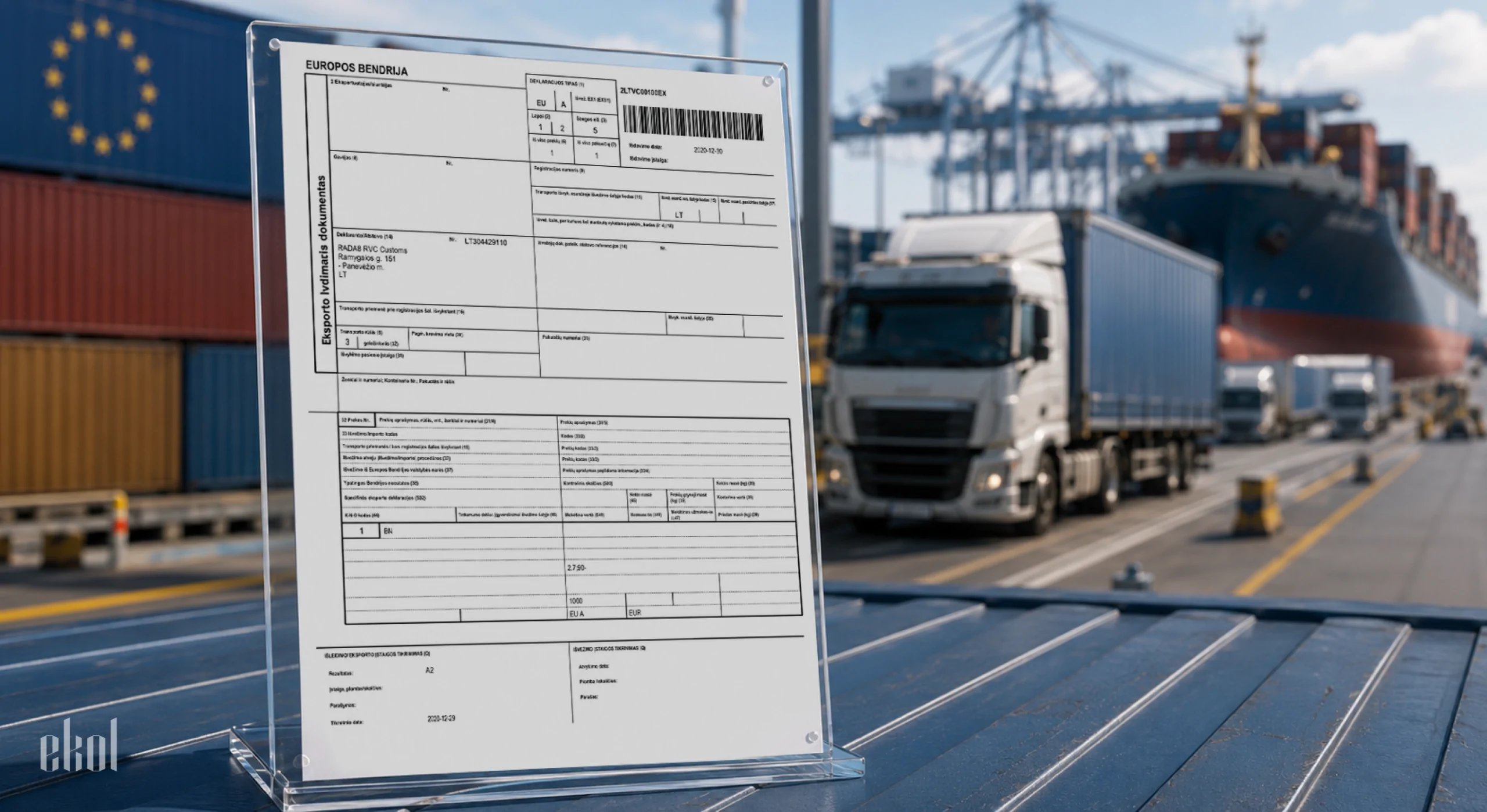
Export requires proper customs clearance and document preparation. For businesses, it is important not only to deliver the goods but also to successfully complete all procedures when crossing the border. To confirm the legality of moving cargo out of the country, an export declaration EX-1 is required.
What Is the Export Declaration EX-1
Before starting international shipments, it is worth familiarizing yourself with the basic principles of customs clearance. The EX-1 declaration is used as the primary customs document for such transportation.
It contains information about the sender and recipient, the invoice, the contract, as well as the HS code and product tariff. In effect, the declaration confirms that the cargo has passed inspection and can legally continue its journey.
Ekol Logistics experts emphasize that the document is used not only by customs authorities. For participants in foreign economic activity, it confirms that the export procedure has been completed in accordance with current legal requirements. In addition, this data is important for monitoring the movement of the shipment and its lawful exportation.
When Is the EX-1 Declaration Required
Understanding what the export declaration is needed for helps to establish international transportation and pass customs control.
EX-1 for export is used when taking products out of the EU or transiting through several countries.
| Situation | Description |
| Export from the EU | Registration when taking products outside the European Union |
| Transit through countries | Movement of cargo through several customs zones |
| Confirmation of origin | Need to obtain certificates and apply trade agreements |
| Customs control | Verification of the legality of the export operation and cargo movement |
This way, businesses gain the ability to carry out international transportation without obstacles, significantly reducing the risks of delays and additional inspections.
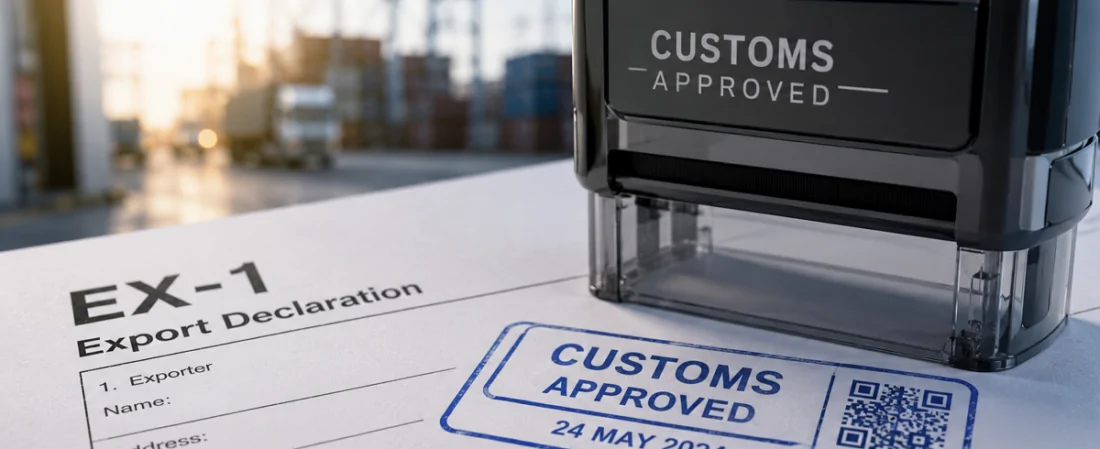
Who Prepares the Export Declaration
EX-1 is usually prepared by a professional broker who has access to customs systems and operates in accordance with legal requirements. The process involves the sender, the carrier, and logistics operators who coordinate cargo movement. Ekol Logistics provides support for the preparation process and monitors procedures at every stage.
Some companies attempt to prepare the paperwork independently, but in practice this often leads to greater time expenditure. Errors in the invoice, HS code, product data, or cargo origin frequently result in more thorough inspections. That is why it is worth working with specialists for whom international delivery is one of the core areas of work.
What Documents Are Required for Preparation
For the EX-1 declaration to be completed correctly, a full set of documents must be prepared. The speed of customs clearance and the risk of additional inspections depend on this.
The basic package includes:
- an invoice with itemized product details;
- a contract between the parties;
- a certificate of origin;
- a product description with the relevant code;
- cargo and packaging information;
- carrier details;
- transit route;
- sender and recipient details.
Having a complete package allows the export process to be significantly accelerated. The more accurately the data is prepared at the initial stage, the lower the likelihood of issues at the border.
How Export Customs Clearance Works
Modern logistics uses multimodal delivery and various transport solutions, which allows for the optimization of cargo movement. Therefore, the procedure includes several sequential stages, each of which is important for successfully passing customs.
First, a set of documents is prepared, after which the data is submitted to the customs system for further processing. The next step is verification of the information and approval.
At every stage, it is important that the information is consistent and matches the actual characteristics of the goods. Particular attention is paid to the product description, customs value, and country of origin. In the event of discrepancies, customs authorities may request additional confirmation and increase their scrutiny.
Professional preparation before submitting the declaration allows the time needed to complete the procedure to be significantly reduced, minimizing the risk of transport delays.
How Much Does EX-1 Preparation Cost
The cost depends on the route, the type of goods, and other factors, including:
- involvement of a customs broker;
- number of documents;
- complexity of the export operation;
- number of transit countries;
- customs requirements.
It is worth noting that there is no fixed price for preparing the declaration. The final cost may be influenced by the specifics of the cargo, a non-standard route, document requirements, or the need to prepare accompanying materials.
Declaration Processing Timeframes
On average, a declaration is processed in anywhere from 30 minutes to 1 business day. The speed depends on the completeness of the data and the load on the state service systems.
If the documents are correctly prepared and require no clarification, the processing can be completed in the shortest possible time. At the same time, during periods of high demand or when discrepancies are present, the timeframe increases.
Common Errors in Declaration Preparation
The most frequent errors involve an incorrect product code, discrepancies in the invoice, and inaccuracies in the sender’s and recipient’s details.
Difficulties also arise from missing certificates or an incorrectly specified transit route, leading to heightened scrutiny. Another common problem is data inconsistency. If information differs, customs authorities may request additional clarification, causing the procedure to drag on and delivery timelines to extend.
How a Customs Broker Helps with EX-1
The role of the intermediary in the process is key, as they are responsible for the accuracy of the data. The broker verifies the official documents, fills in the declaration, and liaises with customs authorities. They monitor the accuracy of the product information, HS code, invoice, cargo origin, and other data required to pass customs.
Ekol Logistics experts note:
“In international logistics, it is precisely the attention to documents that determines how quickly and smoothly cargo will cross the border. That is why companies use modern logistics systems and solutions that help significantly reduce the expenditure of time and resources.”
Conclusion
In the field of international transportation, EX-1 is one of the documents on which the speed and stability of delivery depends. Correctly prepared data helps avoid additional inspections, unnecessary costs, and border delays. It should therefore be approached with the utmost care, especially when it comes to regular product exports.
FAQ
What is the export declaration EX-1?
It is a customs document that confirms the legality of removing goods from the EU and passing through customs.
Who prepares the EX-1?
The export declaration EX-1 is usually prepared by a broker or a logistics company accompanying the international shipment.
Is EX-1 required for all goods?
No, but the export declaration EX-1 is mandatory for the majority of export shipments of goods from the EU.
How long does preparation take?
On average, between 30 minutes and 1 day, depending on the completeness of the documents.
Why is it important to work with a broker?
A broker helps correctly prepare the documents, fill in the declaration, and reduce the risk of errors and delays when passing through customs.
read more
Similar articles
Proper tractor transport across Ukraine starts with assessing the machine’s dimensions and selecting the right type of transport. This approach helps avoid fines and delays along the route.
For years, the domestic market relied on purchases from the PRC, but the era of Chinese factory monopoly is gradually coming to an end. Entrepreneurs are turning to other Asian countries, weighing product quality and partner reliability.
Back in 2021, Ukrainian legislation officially regulated the delivery scheme in which several modes of transport are combined for a single route.
For a business, a logistics company is one reliable partner instead of a dozen separate contractors. It handles communication with carriers and quickly resolves force-majeure situations on the road

Without reliable delivery, a farmer’s harvest won’t reach the market on time. A logistics company for a farmer is not just a service provider — it’s a partner on whom the financial outcome of the season depends.

On the night of July 19, 2026, a massive missile attack severely damaged the Ekol Logistics distribution center located in the AMTEL logistics complex.

Anna
Business development manager

Volodymyr
Business development manager

Artur
Business Development Manager
